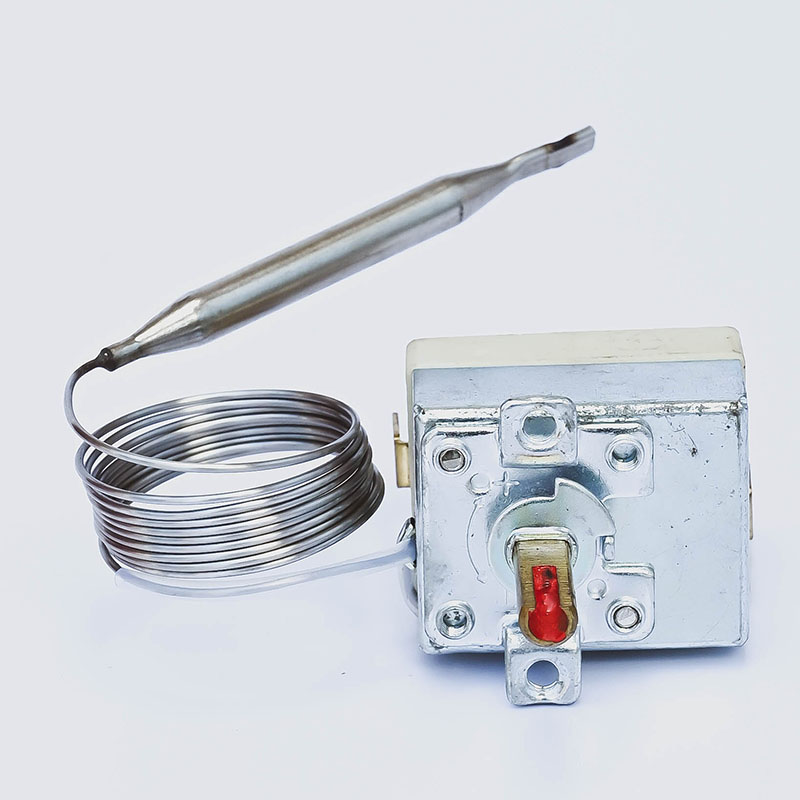
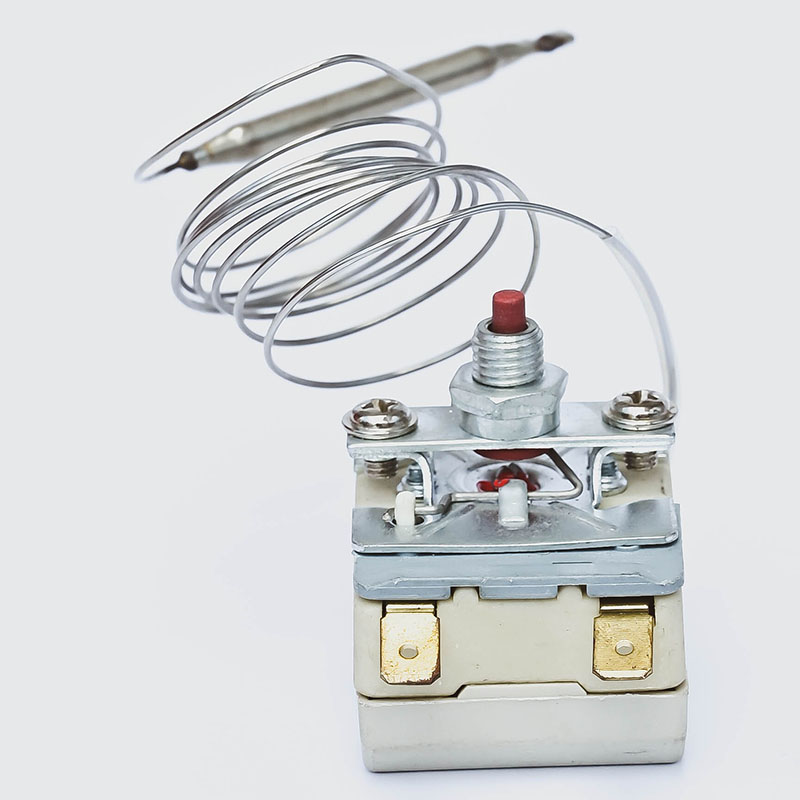
HengTherm's control family covers the two ratings buyers ask for most: HTR-C100 (standard) and HTR-C400 (compact), both rated 16A/20A at 110V/250V, 50–400°C, with SPST/SPDT contacts and a tested mechanical life of 100,000 cycles. Automatic reset, capillary sensing.
Specifications
| HTR-C100 | HTR-C400 | |
|---|---|---|
| Current / voltage | 16A / 20A · 110V / 250V | 16A / 20A · 110V / 250V |
| Temperature range | 50–400°C | 50–400°C |
| Contact | SPST / SPDT | SPST / SPDT |
| Reset | Automatic | Automatic |
| Mechanical life | 100,000 cycles | 100,000 cycles |
| Form factor | Standard | Compact |
Technical data is a catalogue reference. Confirm final ratings, dimensions and approvals for the selected model before ordering.
Applications
- Commercial deep fryers and griddles
- Bakery and convection ovens
- Electric water heaters and boilers
- Food warmers and holding cabinets
Selection guide
- Start with current: check the heating element's power draw. 16A covers most countertop commercial equipment; choose 20A for commercial fryers and continuously running heating circuits.
- Then temperature range: fryers typically run 50–200°C, ovens can exceed 300°C — match the actual operating temperature. Don't oversize the range: control accuracy and service life both suffer.
- SPST or SPDT: single-circuit on/off switching → SPST; one circuit for the heater plus one for a pilot light or alarm → SPDT.
- Capillary length: customize to the distance from the sensing bulb location to the thermostat, leaving slack for cable routing.
FAQ
What is the difference between a capillary thermostat and a bimetal thermostat?
A capillary thermostat senses temperature remotely through a liquid-filled bulb and capillary tube — ideal when the control point is away from the sensing point, e.g. inside a fryer tank. A bimetal thermostat senses at its own mounting location.
Can I get custom temperature ranges or capillary lengths?
Yes. As an OEM manufacturer, we configure setpoint ranges, capillary length, bulb size, and knob format to your equipment.
What is the electrical life of the HTR-C series?
100,000 cycles minimum under rated load, tested in-house.
Do you provide cross-references for replacement parts?
Yes — send the original part number or a photo of the rating label, and we match mounting, ratings, and capillary length.